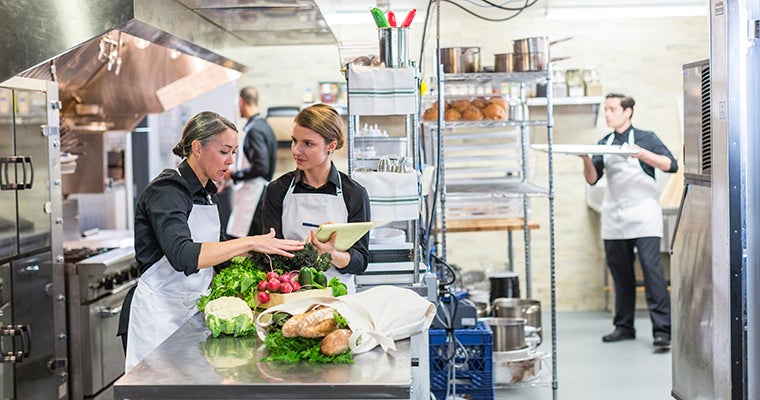
Technology helps restaurants make menu changes efficiently and profitably.
For years, restaurants have been urged to streamline menus for increased profits. Smaller menus come in many flavours—cross-utilization, menu makeovers, LTOs, quarterly menus—all of which require data-driven decisions.
Operators learned during the pandemic to pivot quickly on menu changes for survival. Long-term success, however, takes more than gut decisions, according to Gordon Food Service Business Solutions Specialist Eric Schamp.
You can make some decisions without data, but it’s so important to get it right that you should be calling on data, whether it’s your POS system, a recipe program, an inventory program—you’ve got to use that data to make decisions,” he said.
He suggests several ways operators can use menu data to manage profits while dealing with the labour shortage, supply-chain challenges and unstable pricing.
Develop a menu strategy
Ideally, a new menu should be built once a year. Your Gordon Food Service Sales Representative can show you a menu guide to help with decision-making, Schamp says.
“You can create a worksheet for right-sizing your menu or ask about value-added products that actually save time and labour for your kitchen staff,” he said. “Ultimately, you want to build recipes your team can prepare consistently with items that are in stock.”
Be ready to adjust
After the menu launch, don’t be afraid to make changes, Schamp notes. That includes making tweaks, thinking about LTOs or even creating a quarterly or seasonal menu. Things to consider:
- What recipes are causing kitchen jam-ups?
- Are there speed-scratch or value-added solutions?
- What menu offerings are most/least profitable?
- Can they be tweaked to improve profits, or should they be dropped?
Call on menu technology
“Significant or long-term changes work best when supported by data. Your POS system and our Recipe Manager tool can really help,” Schamp said. “Operators who aren’t using Recipe Manager see it as an overwhelming project that takes a lot of time, but you don’t have to go all in.”
He suggests starting small. Use your POS to define your 10 best-selling menu offerings. Then work with your Gordon Food Service Sales Representative to plug those into the Recipe Manager application to see if you can find ingredients that will improve profits without compromising quality or affecting labour. “Even just starting with the top five can make a difference, then next month you can add a few more recipes.”
Make menu changes easy
Operators start out with planning and expectations, then technology enables them to quickly assess menu performance. Single-page paper menus and digital menus accessible with QR codes allow flexibility when pricing or product changes occur.
“It’s critical with inflation that once you start a menu, you come back to it often—every month or every two months,” Schamp said. “Then you can make changes or start another menu. It doesn’t have to be a large overhaul, just small changes here or there.”
The menu is never done
The menu is the most important document in every restaurant, but it can be a burden if an operator doesn’t know how it’s performing.
“The most critical part comes after the menu is done. How is the menu actually providing benefits to the business?” Schamp asked. “You don’t just want to design a menu and be done. You want to utilize technology to build a profitable menu that can change to always perform better.”


 English (Canada)
  Français du Canada